Informative Talk on Lightweight Solar Panels at the Universitat Politècnica de València
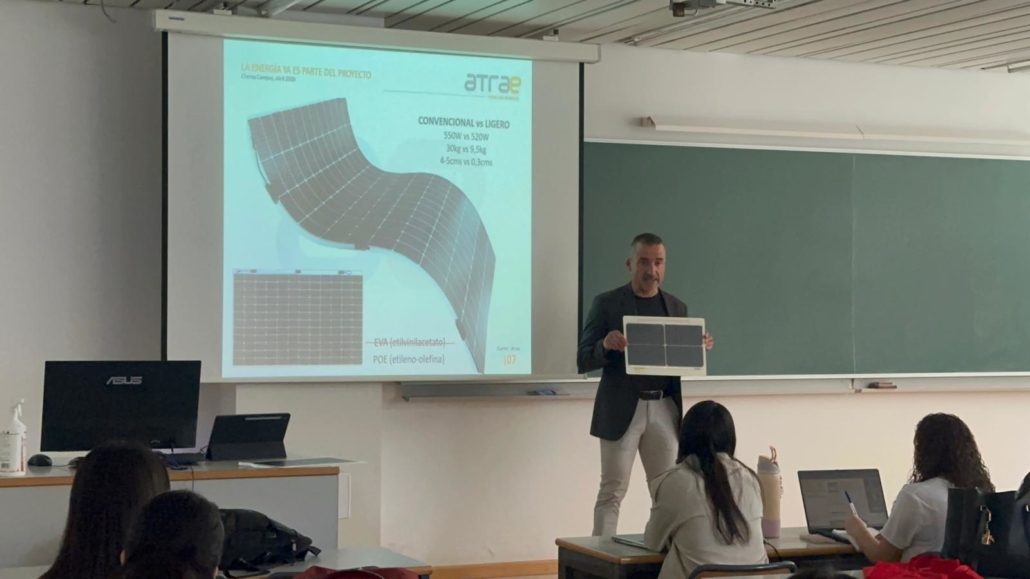
A few weeks ago, I was at the Universitat Politècnica de València.
With 4th-year Architecture students.
Young people, motivated, and still free from many of the professional habits that come with time.
And I left with an uncomfortable conclusion:
They’re ahead of us.
—
When you talk to the more experienced side of the industry, the conversation often revolves around the same old arguments:
• “That looks ugly.”
• “There’s no room for that.”
• “You can’t put that on my building.”
• “That can’t be done.”
The classic handbook of resistance.
—
When you talk to people who haven’t even started their careers yet, the conversation changes.
They don’t ask whether it can be done.
They ask how it can be done better.
—
And this is where the problem (or the opportunity) begins.
For them, energy isn’t an add-on.
It’s not “something we’ll figure out later.”
It’s part of the design.
From day one.
—
Meanwhile, many projects today still work like this:
The building is designed.
It’s completed.
It gets photographed.
And then…
“Let’s see where we can fit the solar panels.”
(I really hate it when people call them “plates” instead of panels.)
Elegant. Very much so.
—
Of course, then come the patches.
Added structures.
Drilling.
Installations that look like an afterthought.
And worst of all:
Architecture that loses its coherence in the final stage.
—
The alternative already exists.
Lightweight rigid and flexible solar panels.
No drilling.
No heavy structures.
No destroying the original geometry.
Curved roofs that remain curved.
Designs that don’t have to compromise at the end of the project.
—
But this isn’t really about panels.
It’s about having the right mindset.
About stopping thinking of energy as a problem and starting to treat it for what it really is:
another part of the design.
—
Because, let’s be clear:
If energy “gets in the way” of your project, it’s not energy’s fault.
—
It’s because someone decided to think about it too late.
—
If you want to do things differently and avoid the last-minute patch…